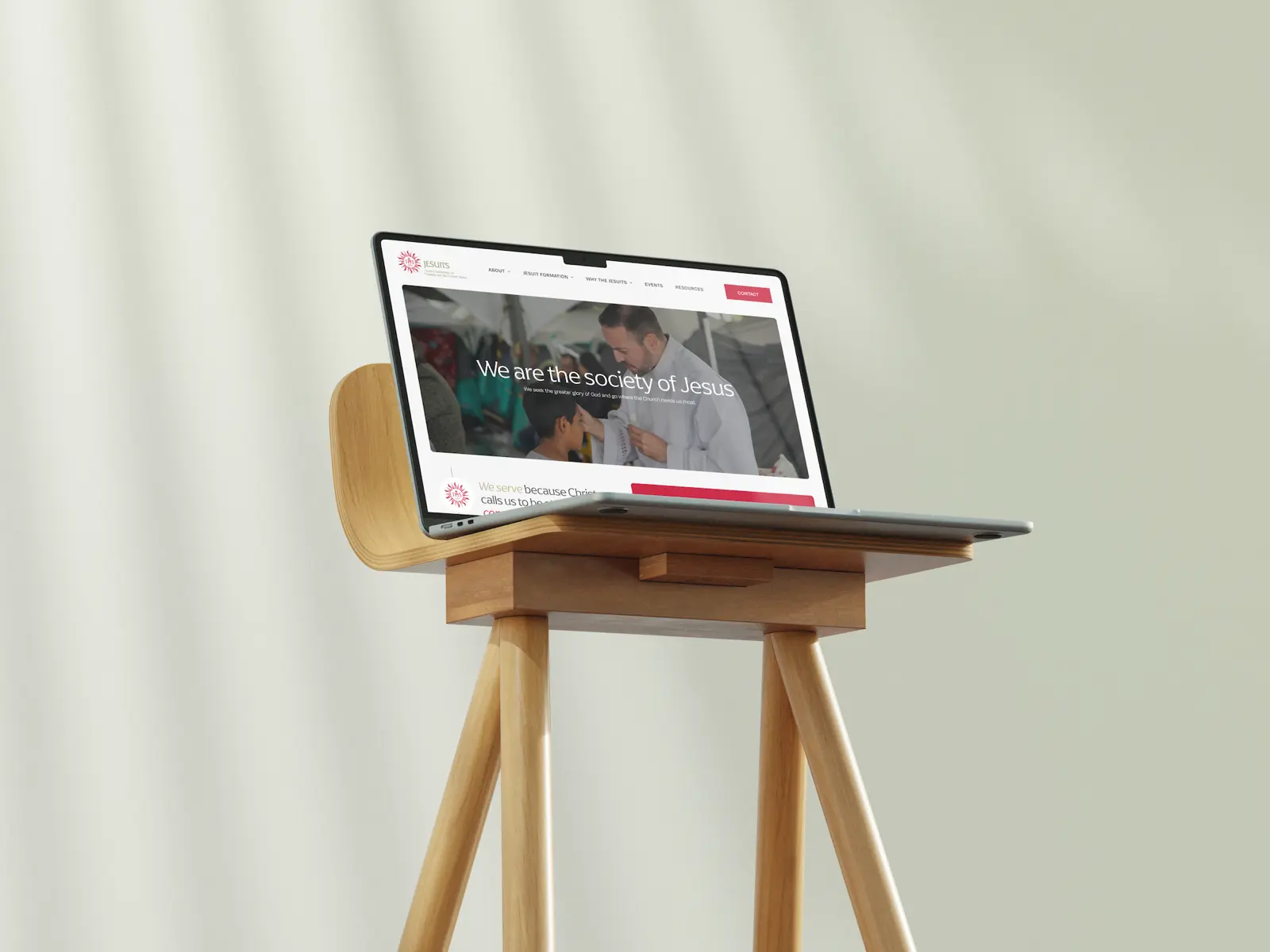

Choosing a web design agency is a meaningful decision for any organization. But for Catholic institutions — a religious community, a diocesan ministry, a Catholic apostolate, or a parish — the stakes carry a different weight.
Choosing a web design agency for a Catholic organization starts with more than reviewing prices and portfolios. Look for a partner with proven Catholic work, an understanding of Church governance and language, strong content strategy, accessible technical execution, and a process that can accommodate multiple stakeholders.
Whether you represent a parish, diocese, religious community, apostolate, or Catholic nonprofit, the right agency should understand that your website is not merely a marketing tool. It is often someone’s first encounter with your mission, community, or charism. This guide explains the questions to ask, the evidence to look for, and the warning signs to avoid.
The stakes are different for Catholic organizations
Your website isn't just a marketing tool. It's often the first encounter someone has with your community, your charism, and your mission. Getting it wrong means more than a missed lead. It means a missed invitation.
Most web agencies are generalists. They'll happily take your project, learn enough about your work to build something functional, and hand it off. Some will do that well. But there's a meaningful difference between an agency that can build a website for a Catholic organization and one that actually understands the world you're operating in — liturgical rhythms, hierarchical governance, the language of discernment, the pastoral sensitivity that shapes how you communicate. That difference shows up in the work.
This isn't a list of things to say to sound rigorous in a vendor meeting. These are the questions and criteria that actually matter — the ones that will help you find a partner who can serve your mission well.
Start with their actual portfolio
Not their homepage. Their actual work. Ask to see websites they've built for Catholic organizations, religious communities, or faith-based nonprofits — and then go look at those sites. Are they well designed? Do they load quickly? Do they feel like they were built with theological literacy, or do they look like a generic nonprofit template with a cross swapped in?
Pay attention to the details. Is the language on those sites accessible without being watered down? Does the design reflect the visual tradition of the Catholic Church — or does it look like it could be for any organization? Has the agency worked with organizations at varying levels of complexity, from a small parish to a multi-province religious order?
Impressive client names on a website mean little without evidence of the work. Look for case studies. Look for specifics — what problem did they solve, how did they approach it, and what were the results? An agency that has genuinely built for Catholic organizations will be able to tell you exactly what they built and why.
Ask about their experience with Church governance
Catholic institutions operate differently than most organizations. A parish has a pastor and a parish council. A diocese has a communications office, a bishop's office, and multiple layers of stakeholder review. A religious community has a provincial, a formation team, and decades of institutional history that shapes every communications decision. A national apostolate has staff members across the country with different opinions about what the website should say.
A web agency that has never worked in this environment will underestimate the complexity. They'll propose timelines that don't account for approval processes. They'll present design options without understanding that certain choices carry theological implications. They'll get frustrated when the project takes longer than expected because they didn't anticipate how decisions get made inside Catholic institutions.
Ask directly: have you worked with diocesan communications offices? Have you navigated stakeholder review processes in a religious community? Have you built sites where content needed to be reviewed for doctrinal accuracy? The answers will tell you quickly whether this agency has real experience or just a few Catholic client names on their portfolio.
Understand how they handle Catholic content and language
One of the most common failures in Catholic web design is language. The Catholic tradition has a rich vocabulary — charism, apostolate, formation, discernment, Ignatian, Franciscan, provincial, novitiate — that means something specific and carries real weight. In the wrong hands, that language either gets stripped out in favor of generic nonprofit speak, or it gets used without context in ways that alienate the people you're trying to reach.
A good agency will ask you about your audiences and help you think through how to communicate with each of them. They'll understand that a website for a religious order needs to speak to prospective vocations, current members, retreat guests, and donors — sometimes all on the same page — and they'll know how to navigate that complexity. They won't try to make your site sound like a tech startup.
Ask how they've approached content strategy for Catholic clients in the past. Ask whether they've worked with theological advisors. Ask how they handle sensitive content — memorials, vocation materials, sacramental scheduling. The answers will reveal whether they see your website as a pastoral tool or just a marketing deliverable.
Technical requirements that matter for Catholic organizations
Beyond the relational and cultural fit, there are specific technical capabilities that come up repeatedly in Catholic web projects. Not every organization needs all of these, but knowing whether an agency has built them before will save you from discovering gaps mid-project.
WordPress Multisite — for dioceses, provinces, or religious orders that need multiple interconnected sites under a shared infrastructure
Liturgical calendar integration — displaying Mass times, feast days, and the liturgical calendar in a way that's accurate and maintainable
Multilingual support — for international religious communities or organizations that serve both English and Spanish-speaking communities
Memorial and legacy databases — for religious communities that want to honor deceased members with searchable profiles
Donation and giving flows — built specifically for mission-driven fundraising, not generic e-commerce checkout
WCAG accessibility compliance — so all the faithful, regardless of ability, can access your spiritual resources
These aren't exotic requirements — they're standard for serious Catholic web projects. An agency with real experience in this space will have built most of them. One that hasn't will be figuring it out on your timeline and at your expense.
Questions to ask in the first conversation
You don't need a lengthy RFP to evaluate a web agency. A focused first conversation can tell you most of what you need to know. Here are the questions that matter most:
Can you walk me through a Catholic organization project you've led from start to finish?
How have you handled stakeholder review processes in faith-based institutions?
Have you built for organizations with complex governance structures — dioceses, provincial networks, or national apostolates?
How do you approach content strategy for organizations that serve multiple audiences?
What does your post-launch support look like, and how do you handle ongoing content management?
Can I speak with a current Catholic organization client as a reference?
A strong agency will answer these questions confidently and specifically. They'll give you names, describe specific challenges they navigated, and speak knowledgeably about the Catholic context without you having to explain it. If you find yourself doing the educating in that first conversation, that's important information.
Ask to see work in your world specifically. Ours is collected on our Catholic web design page, and every project there is a current relationship, not an old portfolio entry.
The right partner is worth the investment
Catholic organizations often operate with constrained budgets and a sense of stewardship around every dollar spent. That instinct is right. But the most expensive decision in Catholic web design isn't hiring an experienced agency — it's hiring the wrong one and spending years with a site that doesn't serve your mission, then doing it all over again.
The right partner brings not just technical skill, but an understanding of why your work matters. They'll care about getting the language right. They'll ask good questions about your community's history and charism. They'll build something that serves the people you're trying to reach — not just something that looks good in a portfolio.
That kind of partnership is rare. But it exists. And it's worth looking for.
Pixel Eye Studio has built digital platforms for Catholic organizations including the Society of Jesus, Busted Halo, the Sisters of Saint Francis, and Verso Ministries. If you're planning a web project for a Catholic organization, we'd love to talk through what you're building. Visit pixeleye.studio/catholic-web-design to learn more about how we work.

Let’s keep in touch.
We share work, insights, and behind-the-scenes process on LinkedIn and Instagram. Follow along.